
The One In One Out Rule: A Practical Guide for Managing Stuff Without Decluttering Everything
A coat rack with three jackets hanging behind the door. A kitchen drawer that barely closes because of duplicate spatulas. A bookshelf with two neat rows and one uneven stack lying sideways on top. This article is a practical guide to using the one in one out rule to manage everyday household items in real spaces like closets, drawers, cabinets, and shelves. It explains how the rule works, where it helps, and where it quietly breaks down if it’s applied too broadly. The scope is intentionally limited to physical belongings coming into the home, not emotional clutter, digital files, or full-home decluttering projects. The constraints are real: limited storage, shared households, and low tolerance for complicated systems. What follows is not a philosophy. It’s a set of grounded decisions you can apply one item at a time.
What the one in one out rule actually refers to in a real home
The one in one out rule applies at the moment a physical object enters your home. A new shirt, a new mug, a new notebook, a new tool. The rule means that when one item comes in, one comparable item leaves. Comparable is the key word. A new winter coat pairs with an old winter coat, not a pile of expired coupons or a random sock. This is not a decluttering method for existing piles. It’s a boundary for future accumulation.
In practice, this happens in specific locations. A clothes closet. A kitchen cabinet. A bathroom drawer. The rule works best in spaces where items already serve the same function and compete for the same storage. It does not ask you to review everything you own. It only asks you to look at what is already occupying the slot the new item wants.
This is a how-to approach, not a mindset shift. When you bring something home, pause at the storage location it will live in. Open the drawer or door. Identify one item that is similar enough to replace. Remove it. That’s the entire action.
If no comparable item exists, that’s useful information. It means the category is growing, not rotating. At that point, the rule has done its job by revealing pressure, not by forcing a decision you’re not ready to make.
Why this rule works best at the point of entry, not later
The one in one out rule fails when people try to apply it retroactively. Standing in front of an overfilled closet and telling yourself that for every shirt you keep, one must go is exhausting and abstract. The rule is designed for the moment of entry, when comparison is easiest and memory is fresh.
At the point of entry, you can still see the difference between the new item and the old one. You know why you bought it. You can feel whether it replaces something or just adds to the pile. This clarity fades quickly once the item is absorbed into the home.
Physically, this looks like stopping before the hanger goes on the rod or before the box is shoved onto a shelf. You hold the new item. You scan what’s already there. You choose one thing that now has less reason to stay.
This approach reduces decision fatigue because it limits the decision set to two objects, not an entire category. You’re not judging your past choices. You’re simply choosing which item earns the space today.
If you skip this moment, the rule becomes theoretical. Applied later, it turns into another decluttering promise that never quite matches the mess in front of you. Applied early, it stays small and contained.
How to choose the “out” item without creating a second problem
Choosing what goes out is where people often stall. The rule feels simple until the removed item has nowhere obvious to land. To keep this practical, the “out” item needs a defined next step before you remove it from storage.
There are only three realistic paths: trash, donate, or immediate use elsewhere. Decide which one applies before you take the item out. If it’s trash, put it directly in the bin. If it’s a donation, place it in a clearly defined donation container, not a temporary pile. If it’s being reassigned, walk it to that location immediately.
Avoid creating a fourth category called “decide later.” That category is how the rule quietly fails. An item that leaves the closet but sits on a chair for weeks is still occupying mental and physical space.
This rule does not require perfect judgment. You are not required to pick the worst item, the oldest item, or the most wasteful mistake. You are only picking the item that now has less purpose than the new one. That’s a narrow decision.
Once the item is out and moved to its next destination, the action is complete. No review. No optimization. Stop there.
Where the one in one out rule breaks down if you apply it everywhere
The rule is often presented as universal, but it doesn’t function well in every category. Applying it indiscriminately can create friction and quiet resistance. The rule works best in stable categories with natural limits, like clothing, dishes, books, and tools.
It breaks down in consumable categories. Replacing a half-used shampoo bottle with a new one does not require throwing something out. The same is true for groceries, office supplies used daily, or children’s school materials during the year. Forcing a one out decision here creates waste or artificial scarcity.
It also struggles in growth phases. A new hobby, a temporary medical need, or a household change can legitimately increase volume. In these cases, the rule becomes a signal rather than a command. If storage starts to strain, you note it. You don’t force balance prematurely.
Another weak spot is sentimental storage. Trying to apply one in one out to memory boxes or inherited items often triggers avoidance. Those categories require different handling and are outside the scope of this guide.
Using the rule selectively keeps it functional. It is a tool for maintenance, not a moral standard for owning things.
How to use the rule as a pressure gauge instead of a strict law
When used gently, the one in one out rule acts as a pressure gauge for your storage, not a rigid law you must obey. Each time you hesitate, that hesitation tells you something specific. Either the category is too tight, the new item isn’t truly needed, or the existing items all still earn their place.
You don’t need to resolve that immediately. You only need to notice it. If you repeatedly can’t find an “out” item in a category, that category may need more space, fewer incoming items, or a future review. The rule surfaces this information without requiring action on the spot.
In practice, this looks like pausing, noticing the resistance, and choosing to delay the purchase or store the item temporarily outside the main space. That pause alone prevents automatic accumulation.
This version of the rule is still doing its job. It slows intake. It protects existing storage. It keeps decisions small.
You stop when the item is placed and the pressure is acknowledged. That’s enough for now.
Applying the rule inside a crowded closet without emptying it first
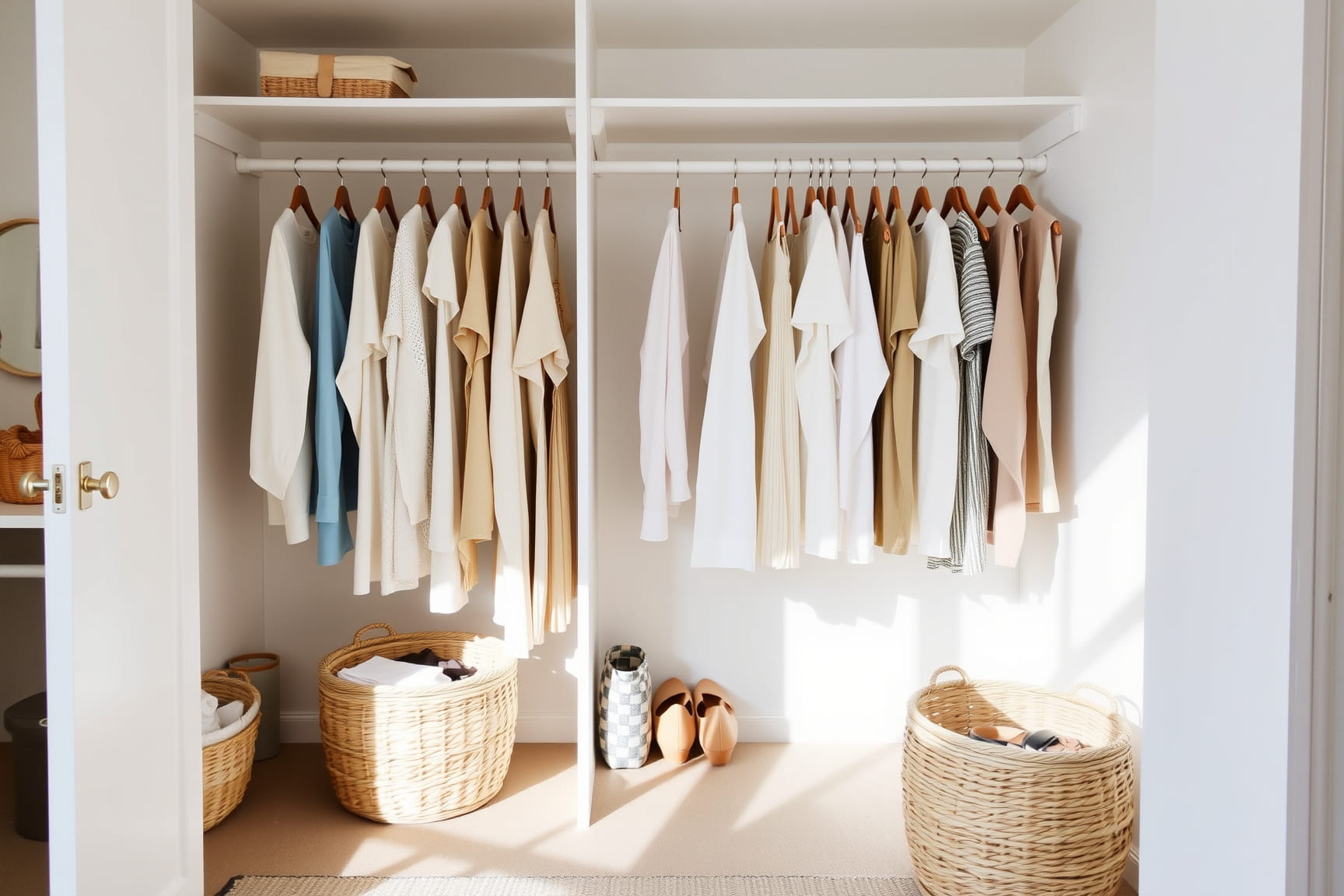
A clothes closet with a packed rod, mixed hangers, and shoes stacked along the floor is one of the most common places people try the one in one out rule. This is also where people overcomplicate it. You do not need to empty the closet or sort by season for the rule to work.
The action starts with the new item in your hands. A jacket, a pair of jeans, a dress. Stand in front of the section of the closet where it will live. Slide hangers apart just enough to see what’s already there. You are not scanning the whole closet. You are only looking at items that directly compete for the same type of space.
Choose one item that now loses the comparison. That might be the jacket that no longer fits well over layers or the jeans you skip every laundry cycle. You don’t need to justify the choice beyond that.
Remove the item from the rod immediately. If it’s wearable but unwanted, place it directly into a donation bag kept in the closet. If it’s worn out, take it straight to the trash or textile recycling. Do not drape it over a chair.
Once the hanger is free and the new item is hung, stop. Close the closet door. The rule has been applied without turning the closet into a project.
Using one in one out in kitchen cabinets and drawers
Kitchen cabinets fill quietly. An extra mug here, a new pan there. The one in one out rule works well in kitchens because storage is rigid. Cabinets don’t expand, and duplicates stack fast.
Start at the cabinet, not the countertop. If you bring home a new mug, open the mug shelf. Take everything out just enough to see what’s there, but don’t remove it all. Pick one mug that is chipped, mismatched, or always passed over. That mug is the “out.”
The same applies to utensils and tools. A new spatula replaces an old warped one. A new baking dish replaces the one that never heats evenly. Comparable function matters more than identical shape.
Avoid cross-category trades. A new blender does not justify throwing out old takeout containers. That breaks the logic of the rule and creates confusion later.
Once the “out” item is chosen, move it directly to its exit. Trash for broken items. Donation for usable duplicates. Do not store it under the sink “just in case.”
Kitchen decisions feel heavier when delayed. Done at the cabinet, with the new item present, the decision stays narrow and manageable.
How the rule works in shared households without starting conflict
In shared homes, the one in one out rule needs clarity to avoid tension. The rule only applies to items you personally bring in, not shared property by default. This boundary matters.
If you buy a new sweater, you choose what leaves your side of the closet. If you bring in a new coffee mug for yourself, you choose from your own mugs or from clearly designated personal space. You do not quietly remove someone else’s item to balance your purchase.
For shared categories like dishes or tools, the rule works best when discussed once, briefly. Agree that when new items enter, older or less-used shared items will be reviewed together or placed in a neutral donation box for later agreement.
If that conversation isn’t realistic, limit the rule to personal zones: your drawer, your shelf, your half of the closet. The rule still protects space without requiring household buy-in.
The key constraint here is respect. The rule is a personal intake boundary, not a household enforcement mechanism.
Used this way, it reduces clutter without turning into a control issue or a silent source of resentment.
Handling gifts and unexpected items with the rule
Gifts and hand-me-downs are where the one in one out rule feels emotionally complicated. The rule still applies, but the timing can shift.
When a gift enters the home, you are allowed to let it rest briefly. Display it. Use it once. This is not avoidance; it’s information gathering. After that short period, decide whether it earns permanent space.
At that point, bring the rule back in. If the item stays, something comparable goes. If nothing feels replaceable, that’s a sign the item may not fit your space long-term.
You are not required to keep every gift to honor the giver. The rule helps separate appreciation from storage obligation.
For bulk hand-me-downs, treat the batch as the “one in.” Select what truly fits your needs, then choose an equivalent volume or category to exit. The rest can leave immediately.
The rule here prevents temporary generosity from becoming permanent overflow.
When to pause the rule instead of forcing balance
There are moments when forcing one in one out creates more stress than relief. Temporary life phases are the most common example. Recovery supplies, work materials, or short-term projects may legitimately increase volume.
In these cases, pause the rule consciously. Name the category as temporary. Choose a defined holding space, like one bin or one shelf. This keeps the expansion contained.
The rule resumes when the phase ends. At that point, the temporary items become the “in,” and outdated or unused items can become the “out.”
Pausing the rule is not failure. It’s maintenance with context.
The important part is not pretending the pause doesn’t exist. By naming it, you prevent the temporary from quietly becoming permanent.
Once the container is full or the phase ends, you stop. No retroactive punishment. Just return to one decision at a time.
Using the rule to stop paper piles from growing quietly
Paper enters the house in predictable ways: mail, school notices, manuals, receipts. The one in one out rule can work here, but only if it’s applied at the point where paper usually stalls. That point is not the filing cabinet. It’s the counter, the desk corner, or the chair where stacks form.
When a new paper comes in, decide where it belongs before setting it down. If it’s reference paper, open the folder or binder it would live in. Remove one outdated or duplicate sheet from that same folder. That sheet is the “out.”
This only works when categories are tight. Instruction manuals replace older manuals. Tax documents replace prior-year drafts, not permanent records. School papers replace earlier versions, not artwork you’ve already decided to keep.
Avoid pairing unrelated paper just to satisfy the rule. A utility bill does not cancel out an old greeting card. That shortcut creates mixed stacks that are harder to manage later.
If a paper has no clear category yet, that’s a signal. Create one temporary holding folder labeled clearly. When that folder fills, it becomes the “in,” and something comparable must leave before more paper is added.
Paper feels endless because it’s flat and quiet. Applied early, the rule keeps it from spreading without requiring a full filing overhaul.
Clothing purchases and returns: using the rule before tags come off
Clothing is one of the easiest categories for the one in one out rule because comparison is immediate. It’s also where people delay decisions by keeping return tags on indefinitely.
When you bring a clothing item home, try it on once. Not later. Not after laundry. Once. Then go directly to the storage location it would live in. This is the decision point.
If the new item stays, remove one comparable piece right then. Same season, same function. A new black sweater replaces another black sweater, not workout clothes or accessories.
If you cannot choose an “out” item without discomfort, pause. That hesitation often means the new item is not clearly better than what you own. In that case, keep the tags on and place the item back in its bag or on a separate hanger. That item becomes the one waiting to earn space.
The rule here protects your closet by forcing clarity early. It prevents the slow accumulation of “maybe” clothes that feel useful but never quite integrate.
Once the decision is made and one item leaves, stop. Do not reassess the rest of the closet. The rule is complete for that purchase.
How to apply the rule to storage containers themselves
Storage containers are often brought in to solve clutter, but they can quietly become clutter themselves. Extra bins, baskets, and organizers stack up unused, waiting for a future purpose.
When a new container comes into the house, the one in one out rule applies to containers, not contents. Look at where containers are stored: the garage shelf, the laundry room cabinet, the closet floor.
Choose one existing container that is cracked, mismatched, unused, or less functional. That container is the “out.” It leaves before the new one is put into service.
Do not justify keeping all containers because they might be useful later. That logic turns storage into inventory. Containers should earn their space by actively holding something now.
If the new container replaces no existing container, that’s a sign that storage is expanding. Pause before assigning it a job. Ask what problem it solves that existing containers don’t.
This use of the rule prevents the common cycle of buying organizers while storage areas quietly overflow with empty ones.
Once the swap is made or consciously deferred, stop. The rule is about limits, not perfect organization.
Children’s items and growth-related overflow
Children’s items change quickly: clothes, books, toys, supplies. The one in one out rule can help here, but only when adjusted for growth.
For clothing, the rule works cleanly. When a larger size comes in, remove a smaller size that no longer fits. Store or donate immediately. Do not keep multiple sizes mixed together “just in case.”
For toys and books, apply the rule by category and age range. A new puzzle replaces an outgrown one. A new picture book replaces one that no longer holds attention.
Avoid forcing emotional decisions in front of the child every time. Instead, set aside the “out” item quietly and review donation together periodically, or move items out once interest has clearly passed.
School supplies often require temporary expansion. Pause the rule during the school year if needed, then apply it at natural reset points like the end of a term.
The goal is not minimalism. It’s preventing storage from permanently reflecting past stages that no longer match current use.
Recognizing when the rule is doing enough on its own
The one in one out rule is maintenance, not transformation. Its success is quiet. Drawers close more easily. Shelves stop bowing. You don’t need to reorganize as often.
If you find yourself wanting to “do more,” pause. That urge often comes from seeing progress and wanting to capitalize on it. The rule doesn’t require escalation.
Notice whether new items are entering more slowly. Notice whether hesitation appears before purchases. Those are signs the rule is working upstream.
If clutter still exists, that doesn’t mean the rule failed. It means it’s doing its narrow job: preventing additional pressure while you live your life.
You can stop using the rule in any category that feels stable. You can reapply it when things start to creep again.
At this point, the work is contained. No expansion is required.