
Seasonal Decluttering: A Practical, Room-by-Room Reset for Items You Actually Touch

Seasonal decluttering deals with coats hanging past their weather, shoes piled by the door, linens stacked in closets, and gear tucked into corners once its season ends. This is a practical how-to guide focused on physical items in real rooms: entryways, closets, cabinets, and storage bins. It covers what to do with what you already own when the season shifts, not how to overhaul your lifestyle or create a long-term system. The scope is intentionally limited to visible, everyday categories and assumes limited time, shared space, and decision fatigue. Each section resolves one concrete decision so you can stop at any point without losing the thread.
What Seasonal Decluttering Actually Covers (and What It Doesn’t)
Seasonal decluttering focuses on items that rotate in and out of daily use as weather, routines, or holidays change. Think winter coats on hooks, summer sandals by the door, extra blankets folded on shelves, sports gear leaning in corners, and holiday-specific kitchen tools tucked into drawers. These are not sentimental archives or deep-storage heirlooms. They are items you touch during one part of the year and then forget about until they get in the way.
This is a how-to guide for managing those items without expanding the task into a full-house purge. The goal is to adjust access, volume, and placement based on what you actually need right now. That means deciding what stays within arm’s reach, what gets moved to secondary storage, and what no longer earns space at all.
Seasonal decluttering does not include digitizing files, sorting memorabilia, or redefining your identity around minimalism. It also does not require buying containers or labeling systems. The work happens with what you already have: shelves, hooks, bins, and floor space.
If your home is shared, this approach works because it limits decisions to neutral categories like outerwear, footwear, and equipment. If time is tight, each decision is contained. You can stop after one drawer or one shelf and still see a physical result.
Start Where the Season Physically Shows Up First
The easiest place to begin seasonal decluttering is where the season announces itself every day. Entryways fill with boots, hats, umbrellas, sunscreen, or gloves. Closets show the shift through crowded rods and unreachable shelves. These areas create friction because they are used daily and clog quickly.
This section is a step-by-step approach. Stand in the space and touch only what is currently in use for the active season. For example, if it’s warm, pull forward sandals, light jackets, and reusable bags. If it’s cold, bring coats, scarves, and boots into clear reach. Everything else is temporarily treated as “off-season,” not as clutter yet.
Move off-season items together, even if you don’t know their final home. A single box, laundry basket, or pile is enough. This action alone reduces visual noise and daily effort. You are not deciding what to keep forever. You are deciding what should not block today’s routine.
If the space is shared, don’t negotiate yet. Group items by season first. That creates a neutral baseline before any further decisions are needed.
Sorting by Use Frequency, Not by Category
Seasonal decluttering works best when you sort by how often something is used during this season, not by what it is. In a closet, that means separating “worn weekly” from “might wear once” and “won’t wear at all until next season.” In a kitchen, it might be daily tools versus holiday-only equipment.
This is a practical guide step. Take one shelf, drawer, or section of a rod. Touch each item and ask one question: “Did I use this in the last four weeks?” Place yes-items back immediately. Place no-items into an off-season group.
Avoid subcategories. Do not split by color, type, or ideal future use. Frequency answers faster and creates less resistance. It also respects limited time and energy.
If something belongs to another household member, still sort by frequency. You are not deciding ownership, only access. Items used rarely do not need prime placement.
Once the space contains mostly yes-items, stop. That is a clean exit point. You can leave off-season items grouped without storing them perfectly. The room will already function better, which is the point of this phase.
Containing Off-Season Items Without Creating New Projects
After sorting, off-season items need containment, not optimization. Seasonal decluttering often stalls here because storage feels like a separate project. It doesn’t have to be. Use the nearest available container: a bin, suitcase, tote bag, or even a labeled cardboard box.
This how-to step is simple. Place off-season items together and store them where access is possible but inconvenient: top shelves, under beds, back of closets, or garage edges. You are not organizing for display. You are clearing active space.
Do not decant or over-sort. Keep pairs together, keep sets intact, and avoid folding perfection. The goal is retrieval later, not aesthetics now.
If space is limited, stack vertically rather than spreading out. One tall pile is easier to ignore than multiple small ones. If sharing storage, keep seasonal groups distinct so retrieval does not require re-sorting.
At this stage, you are done with that category. You can stop without guilt. The home now reflects the current season instead of fighting it.
Letting Go of Seasonal Items That Missed Their Moment
Seasonal decluttering naturally reveals items that stayed unused through an entire season. These might be coats never worn, decorations never unpacked, or gear you avoided because it didn’t fit or function well. This section addresses what to do with those items without escalating into a purge.
This is a decision-based step, not an emotional one. If an item missed its season entirely, it failed its job this year. That does not require justification beyond that fact. Place these items in a separate, small group.
Choose one action only: donate, recycle, or discard. Do not store these items “just in case.” If they weren’t used when conditions were perfect, they are unlikely to earn space later.
Limit this step to what surfaced naturally. Do not go hunting for more. Seasonal decluttering is not about extracting maximum volume. It is about reducing friction where it already exists.
Once these items leave the space, stop. The task is complete enough for now.
Adjusting Closets as the Weather Shifts
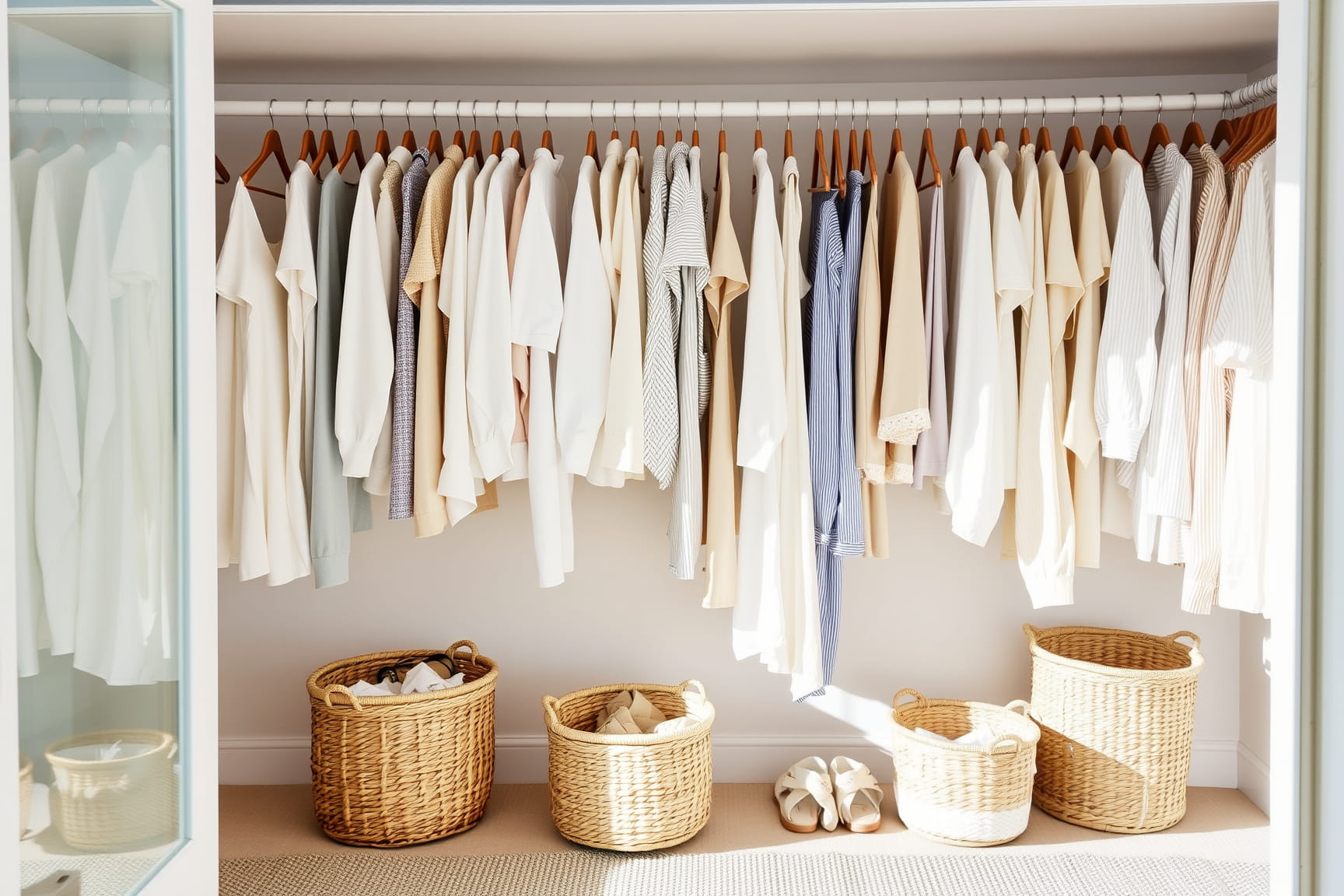
Closets feel the pressure of seasonal change faster than most rooms. Coats crowd lighter jackets, shoes stack without pairs, and shelves become layered with items meant for different temperatures. Seasonal decluttering in closets is a how-to process of restoring reach, not reimagining the wardrobe.
Start with the rod. Slide all hangers to one side. Pull back only the clothes suitable for the current season. These stay centered and spaced so you can see them. Anything heavy, bulky, or weather-specific gets pushed to the far ends or removed entirely. You are not deciding what to keep long-term. You are deciding what earns the middle of the rod right now.
Next, address the floor. Shoes worn weekly stay out. Shoes not worn in the last month get boxed or bagged together. One container is enough. Avoid spreading pairs across multiple shelves.
Shelves come last. Folded items should match the season in weight and function. Thick sweaters do not belong on eye-level shelves in summer. Move them upward or off-site.
If the closet is shared, claim only your section. Seasonal decluttering works best when boundaries are respected. Once your area reflects the season, stop. The closet will already open and close more easily, which is the immediate relief this step is meant to provide.
Seasonal Decluttering for Entryways and Drop Zones
Entryways collect seasonal overflow quickly: boots lingering into spring, sunscreen buried under gloves, umbrellas multiplying. This section is a practical guide to resetting that space without expanding it into a storage overhaul.
Stand in the entryway and remove everything from hooks, benches, and the floor. Place items into three loose groups: current season, off-season, and unknown. Unknown items are things that don’t clearly belong but ended up there anyway.
Return current-season items first. Limit hooks and floor space to what gets used several times a week. This boundary matters. When too many items are allowed back, the space fails again within days.
Off-season items leave the entryway entirely. They do not need final storage yet. A bag or box placed just outside the space is enough for now.
The unknown group is handled last. Choose one action: relocate to the correct room or discard if broken or expired. Do not create a “temporary” pile here.
Once walking through the entryway feels unobstructed, stop. Seasonal decluttering here is complete. You do not need decorative solutions or additional furniture. Clear passage and visible essentials are the only measures of success.
Rotating Seasonal Items in the Kitchen
Kitchens change with the season through tools and habits. Slow cookers, holiday bakeware, grills, large pitchers, or insulated mugs appear and disappear throughout the year. Seasonal decluttering in the kitchen is a step-by-step adjustment of access, not a full cabinet reset.
Choose one cabinet or drawer where seasonal items tend to gather. Remove everything. Identify which tools you’ve used in the last month. These go back first, closest to the front.
Items tied to another season get grouped together. Do not scatter them across cabinets. One shelf or bin is enough. If space is tight, place them higher or farther back.
This is not the time to evaluate recipes or aspirational cooking. Frequency decides placement. If something hasn’t been used since last year’s holiday season, it does not need daily access.
Duplicates become visible during this step. Choose the one you reach for most often. The rest can be boxed with off-season items or removed entirely.
Once the cabinet closes easily and the front row contains only current-use tools, stop. You do not need to reorganize the entire kitchen. This single adjustment supports daily cooking without creating more work.
Managing Seasonal Gear Without Filling the Garage
Seasonal gear—sports equipment, yard tools, hobby supplies—often migrates into garages, sheds, or spare rooms. Seasonal decluttering here is about containment and visibility, not perfect order.
Gather gear by season. Bikes, helmets, and outdoor toys for warm months go together. Snow shovels, sleds, or heaters group separately. Do this in one area so you can see volume clearly.
Keep current-season gear accessible and upright. Leaning piles fall and spread. Use walls and corners first. Off-season gear moves back or up, even if that means stacking temporarily.
Avoid mixing seasons within bins. Labeling is optional, but separation is not. Mixed storage guarantees re-sorting later.
If space is shared, keep gear grouped by user as well as season. This reduces friction when someone needs access quickly.
Do not attempt repairs or upgrades during this step. Broken items can be set aside, but fixing them is not part of seasonal decluttering.
Once current gear is reachable without moving other items, stop. The space now supports use instead of storage, which is enough for this phase.
Handling Seasonal Decorations Without Letting Them Spread
Decorations tied to holidays or seasons often expand beyond their original containers. Seasonal decluttering here is a how-to process for consolidation, not reduction unless items clearly no longer function.
Bring all decorations for one season into one area. This may mean pulling boxes from closets, shelves, or under beds. Seeing them together prevents overbuying and duplicate storage.
Check containers first. If items no longer fit, choose one solution: remove excess or upgrade to a single larger container. Avoid splitting into multiple small boxes, which increases spread.
Broken lights, damaged décor, or incomplete sets are addressed now. Decide once: discard or keep. Do not return broken items to storage.
Store decorations together and clearly separate them from other seasonal items like clothing or gear. Mixing categories creates confusion later.
Place the container in a location that matches retrieval frequency. Once-a-year items go farthest away.
When the box is closed and returned to storage, stop. Seasonal decluttering for decorations does not require sorting by color, theme, or future plans. Containment and completeness are the only goals here.
Seasonal Decluttering for Linens and Bedding
Linens change with the season more than most people realize. Heavy blankets, flannel sheets, cooling covers, extra throws, and guest bedding often end up mixed together on shelves. Seasonal decluttering here is a how-to process for restoring stack integrity and access.
Start by pulling all bedding from one storage location. Do not search the whole house. Work with what is already grouped. Separate items by current use versus off-season weight. For warm months, that might mean light sheets and thin blankets. For cold months, heavier layers return to the front.
Make stacks only as tall as you can lift easily. Overstacked shelves collapse and create rework. If a shelf cannot hold both seasons comfortably, off-season items move out entirely to a bin or upper shelf.
Match sets only if they are complete. If pillowcases or fitted sheets are missing, store the partial set together or remove it. Mixed singles increase daily friction.
Guest linens are treated as off-season unless guests are expected soon. They do not need prime placement year-round.
Once the shelf closes neatly and the front stack matches current use, stop. Linen closets respond quickly to small adjustments. No further sorting is required.
Children’s Seasonal Items Without Over-Sorting
Children’s clothing, shoes, and gear rotate fast and multiply faster. Seasonal decluttering here focuses on size, weather, and reach—not memory or future planning.
Choose one category at a time: coats, shoes, or accessories. Pull only that category into the open. Sort into three groups: fits now, off-season but fits, and outgrown.
Fits-now items go back immediately and should be easy for the child to reach if age-appropriate. Off-season but usable items get boxed together by size. Labeling is optional; grouping is not.
Outgrown items leave the room. Decide one action: donate, hand down, or store short-term if there is a clear recipient. Avoid creating a long-term holding pile.
Do not sort by outfits or future seasons beyond the next size. Seasonal decluttering works because it limits decisions.
Once the drawer or hook area reflects current weather and size, stop. You can return later for the next growth stage. This phase is complete enough for now.
Seasonal Decluttering in Bathrooms and Medicine Storage
Bathrooms shift seasonally through products and routines. Sunscreen, bug spray, allergy medication, heavy lotions, heating pads, or humidifiers appear and disappear. This is a step-by-step guide for managing that rotation safely.
Start with one cabinet or shelf. Remove everything and check expiration dates first. Expired items are discarded immediately. This decision requires no further evaluation.
Next, separate items used in the current season from those tied to another time of year. Current-use items return to the front. Off-season products move to the back or into a small bin.
Avoid decanting or consolidating unless something is nearly empty. Half-used products are stored upright together to prevent leaks.
Medical items should stay grouped by function, not season, but frequency still matters. Daily-use items remain accessible. Rare-use items move out of prime space.
Once the cabinet opens without crowding and expired items are gone, stop. Seasonal decluttering in bathrooms prioritizes safety and access over aesthetics.
Shared Spaces and Seasonal Clutter Boundaries
Living rooms, dining areas, and shared shelves collect seasonal items quickly: blankets, fans, heaters, hobby supplies, or decor. Seasonal decluttering in shared spaces is about boundaries, not control.
Identify which seasonal items belong in the shared space during this season. Limit quantity. For example, two blankets on the couch, not five. Excess items leave the room, even if they stay in the home.
Group like items together. Fans belong in one area, not scattered. This makes their presence feel intentional rather than messy.
If the space is shared, communicate the boundary through placement, not rules. When an area looks full, it is full. Do not compress to fit more.
Off-season items should not linger in shared zones. Move them to storage even if that storage is temporary.
Once the room supports its current function without visual clutter, stop. Seasonal decluttering here is successful when the space feels usable, not empty.
Creating a Simple Seasonal Reset Habit
Seasonal decluttering does not require a calendar reminder or a checklist. It works best as a short reset tied to natural transitions: the first hot week, the first cold morning, the end of a holiday.
Choose one trigger that already exists in your routine. When coats change, adjust the closet. When fans come out, store heaters. One trigger equals one small action.
Limit each reset to 30 minutes or one area. Stopping early is part of the design. The habit succeeds because it does not expand.
Keep containers consistent so items return to familiar places each year. Familiarity reduces decision fatigue over time.
If a season passes without a reset, nothing breaks. You simply start again when friction appears.
Once you’ve adjusted one space and daily use feels easier, you’re done for now. Seasonal decluttering is meant to support living, not replace it.