
Signs of Too Much Clutter: Practical Ways to Recognize When Your Home Is Carrying More Than It Can Hold

Paper stacks on the dining table, shoes lining the hallway, cabinets that won’t close, drawers where utensils, batteries, and mail mix together. These are physical states, not personality traits. This article is a practical guide to identifying signs of too much clutter inside real homes with limited storage, shared surfaces, and daily use demands.
What follows is not a mindset discussion or a lifestyle overhaul. It’s a concrete way to recognize when the amount of stuff in a space has exceeded its ability to function. The scope is deliberately narrow: visible, repeatable signals that show up in kitchens, bedrooms, bathrooms, and common storage areas. This is for households with limited time, limited square footage, and a reluctance to make big, sweeping decisions all at once.
Each section names one specific sign, describes what it looks like in real rooms, and explains why it matters operationally. You don’t need to agree with every point or act on all of them. Each section stands alone. You can stop after any one and still have a clear takeaway.
This is a how-to guide for recognition, not a full decluttering plan. No systems, no schedules, no pressure to fix everything at once. Just clear signals you can use to decide whether clutter—not cleanliness, not effort—is the thing getting in the way right now.
Surfaces Are No Longer Resetting on Their Own
Kitchen counters, bathroom sinks, nightstands, and desks are designed to clear naturally through daily use. When clutter exceeds capacity, these surfaces stop resetting. Items land and stay: unopened mail, water bottles, cosmetics, chargers, grocery bags.
This is one of the most reliable signs of too much clutter because it shows a mismatch between volume and available landing space. The issue isn’t that you’re messy or inconsistent. It’s that there are more objects than resting places. Even when you tidy, the same items return because there’s nowhere else for them to go.
Watch for this pattern: you clear a surface, use the space once, and within hours it’s full again. The objects are often unrelated, pulled from multiple rooms, and temporarily parked “just for now.” That temporary state becomes permanent.
This matters because surfaces act as buffers in daily routines. When they’re overloaded, every task takes longer. Cooking requires moving stacks. Brushing teeth involves shifting bottles. Work starts with clearing space instead of using it.
You don’t need to judge the items themselves to recognize this sign. Whether the objects are useful, sentimental, or necessary is irrelevant at this stage. The signal is operational failure. A surface that can’t reset is telling you the space is carrying more than it can hold, regardless of intent.
Drawers and Cabinets Require Rearranging Before Use
A drawer that must be shuffled before opening or a cabinet that only closes if items are angled just right is signaling excess. These storage spaces were built with a fixed volume. When contents exceed that volume, function becomes conditional.
Common examples include utensil drawers that jam, bathroom cabinets where bottles fall forward, or pantry shelves where items must be stacked in layers. You may know where things are, but access requires negotiation. Something has to be moved before something else can be reached.
This is not a sign of poor organization. It’s a sign of density. When every inch is filled, there’s no margin for movement. Daily use compresses items tighter over time, increasing friction with each interaction.
The practical cost shows up as avoidance. You delay putting things away because it’s annoying. You leave items out because returning them feels like work. Over time, this feeds surface clutter and duplicate purchases.
Notice whether storage spaces allow removal and return without adjustment. If each use requires rearranging, the container is overfilled. The problem isn’t how items are arranged inside. It’s that the container has been asked to hold more than it can reliably support.
You Avoid Certain Areas Because They Feel Mentally Loud
Closets, spare rooms, laundry areas, and garages often become avoidance zones when clutter accumulates. You don’t consciously decide to avoid them. You just delay entering unless necessary.
The physical signs are consistent: piles on the floor, mixed categories in bins, items leaning against walls. The mental response is equally consistent. You feel pressure to “deal with it” the moment you step inside, even if that wasn’t your goal.
This reaction isn’t emotional fragility. It’s cognitive overload. When too many unrelated items share a space, your brain can’t quickly categorize what belongs where. The space demands decisions before it allows action.
As a result, you shorten visits. You grab what you need and leave. Maintenance tasks—sorting laundry, putting tools away, returning seasonal items—get postponed because the area feels heavy.
Avoidance is a useful signal. It tells you the space is no longer neutral. Functional spaces should allow entry without requiring judgment calls. When clutter crosses a threshold, presence itself becomes work. That’s not a motivation issue. It’s a volume issue that’s visible long before anything is actually addressed.
You Own Duplicates Because You Can’t Find What You Have
Extra scissors, multiple chargers, unopened toiletries, backup notebooks. Duplicate items often accumulate not because you want them, but because retrieval has become unreliable.
When clutter exceeds organizational clarity, search costs rise. You don’t know where something is, or you know but can’t access it easily. In the moment, buying another feels faster than digging.
This sign shows up most clearly in categories meant for quick access: office supplies, cleaning products, basic tools, and personal care items. You might find three versions later, scattered across rooms or bins.
The problem isn’t memory. It’s visibility. When items are buried, stacked, or mixed with unrelated objects, they effectively disappear. Ownership continues, but access does not.
Duplicates increase clutter density, which further reduces visibility, creating a self-reinforcing loop. Over time, storage fills with “just in case” backups that never get used because the original is eventually found.
Recognizing this pattern matters because it shows clutter creating new clutter. When your environment makes retrieval difficult, acquisition increases to compensate. That’s a structural issue, not a spending habit. The signal is clear: the system can no longer support what it already contains.
Cleaning Takes Longer Than It Should for the Size of the Space
A small bathroom that takes an hour to clean. A modest kitchen that requires multiple rounds of clearing before wiping. The time doesn’t match the square footage.
This happens when cleaning becomes a two-step process: move objects, then clean. The more clutter on surfaces and floors, the more labor is required before actual maintenance can begin.
Pay attention to how often you have to lift, stack, or relocate items just to access the area underneath. Bottles lining the tub, decor covering shelves, shoes filling the floor. None of these are dirty, but all of them slow the task.
Over time, this extended effort discourages routine cleaning. You delay because it feels bigger than it is. Dust and grime accumulate, reinforcing the sense that the space is hard to manage.
This sign is not about cleanliness standards. It’s about friction. When the environment adds steps to basic care, it’s signaling overload. A space carrying the right amount of stuff allows maintenance without negotiation.
If cleaning feels disproportionately exhausting, clutter is likely contributing more than you realize. The time cost is a measurable, practical indicator that the volume of objects has exceeded functional limits.
Items Get Shifted Instead of Put Away
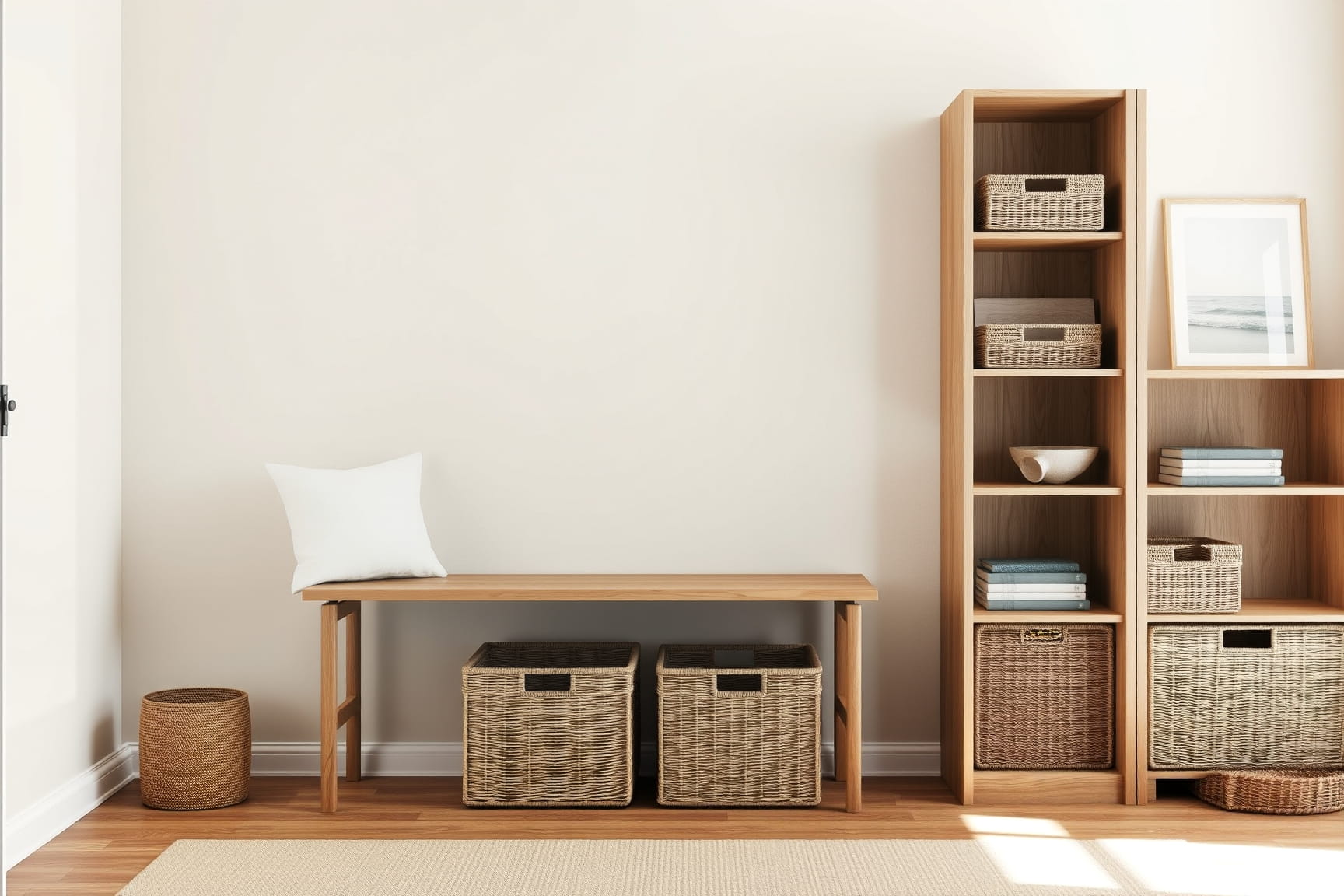
When clutter builds, objects stop completing their full return cycle. Shoes get kicked under a bench instead of placed in the closet. Papers move from the table to a chair. Bags migrate from room to room without ever being unpacked.
This shifting behavior is a strong sign of excess because it shows that “away” no longer exists as a usable destination. You’re not avoiding the task of putting things away—you’re compensating for the lack of available space by relocating items temporarily.
Notice whether objects tend to orbit the same few areas. A jacket moves from the couch to a hook to a chair and back again. A stack of mail travels from counter to desk to shelf. The motion creates the illusion of action without resolution.
This matters because constant shifting consumes time and attention without reducing volume. It also increases visual noise, making spaces feel unsettled even when nothing new has been added.
When storage works, items complete a loop: use → return → rest. When clutter exceeds capacity, the loop breaks. Objects remain in motion because there’s no stable endpoint. That’s not a habit problem. It’s a spatial one, and it shows up clearly in how often you touch the same items without ever finishing with them.
Storage Areas Are Full, But Everyday Items Are Still Out
Closets packed wall to wall. Cabinets filled to the edge. Bins stacked neatly. And yet, daily-use items still live on chairs, counters, and floors.
This mismatch is a key sign of too much clutter. Storage may look “maximized,” but functionally it’s unavailable. When storage is filled with infrequently used or undefined items, it can’t support what you actually need day to day.
Pay attention to what lives outside containers. Coats that never make it to the closet. Shoes that line the hallway despite an empty-looking rack. Bags that hang on door handles instead of hooks inside storage.
This pattern suggests that storage is technically full but practically unusable. Either items inside are blocking access, or the categories stored there don’t match current routines.
The result is overflow into living space. That overflow isn’t random—it’s targeted. The items left out are the ones you reach for most. The items stored away are often the ones you touch least.
This signal matters because it points to a volume imbalance. When storage is consumed by low-use items, high-use items get displaced. You don’t need better containers to see this. You just need to notice where the things you actually use are forced to live.
You Have “Holding Zones” That Never Empty
A chair for clothes. A basket for mail. A box for donations that never gets dropped off. These holding zones start as temporary solutions and slowly become permanent fixtures.
The defining feature isn’t the container itself—it’s the lack of turnover. Items enter but rarely leave. The contents change slightly, but the zone remains full.
Holding zones appear when decisions are delayed repeatedly. Not because you’re indecisive, but because the volume of incoming items exceeds your ability to process them within existing space and time limits.
Common examples include piles near entryways, bags in bedrooms, or boxes in hallways labeled “sort later.” The label becomes a stand-in for action.
This matters because holding zones concentrate unresolved clutter. They pull attention every time you pass but don’t offer a clear next step. Over time, they normalize incompletion.
A functional home may have temporary landing spots, but they clear regularly. When a zone never empties, it’s signaling backlog, not laziness. The system can’t absorb what’s coming in.
Recognizing this sign helps separate true transitional spaces from stalled ones. A holding zone that doesn’t turn over is a visible marker that clutter volume has surpassed your current processing capacity.
You Can’t See What You Own Without Moving Other Things
Visibility is a quiet indicator of clutter overload. When items must be uncovered, unstacked, or dug out to be recognized, they effectively don’t exist in daily decision-making.
This shows up in pantries where cans hide behind boxes, closets where clothing is layered, or storage bins filled to the lid. You may know the items are there, but you can’t see them all at once.
This lack of visibility increases friction. You choose the easiest option instead of the best one. You forget what you have. You buy replacements. You avoid using certain areas because they require effort to interpret.
The issue isn’t transparency or labeling. It’s depth. When storage becomes deep instead of shallow, items disappear into layers.
A useful test is this: can you inventory a space with your eyes alone? If not, the space is carrying more than it can present.
This matters because visibility supports restraint. When you can see what you own, you’re less likely to add more. When you can’t, accumulation accelerates quietly.
Recognizing reduced visibility as a sign of clutter helps shift focus away from organizing techniques and toward volume. If items can’t be seen without excavation, the container has exceeded its functional limit.
Decision Fatigue Shows Up in Small, Repeated Choices
Standing in front of a closet and not knowing what to wear. Opening the fridge and feeling stuck. Looking for a pen and getting distracted by unrelated items. These moments point to decision fatigue caused by clutter density.
When many options occupy a small space, the brain works harder to filter. Each object asks, “Am I relevant right now?” Too many questions slow action.
This isn’t about too many choices in theory. It’s about too many objects in reach at once. Mixed categories amplify the effect. When work items, personal items, and household supplies share space, your brain has to sort before you can act.
Over time, this leads to avoidance. You default to the same choices. You delay tasks that require setup. You feel tired before starting.
This signal matters because it connects clutter to energy, not aesthetics. Decision fatigue is cumulative. It builds from repeated micro-decisions made harder by excess.
If small tasks feel heavier than expected, look at the environment, not your motivation. When clutter crosses a threshold, it taxes attention continuously. Recognizing this sign helps explain why everyday actions feel harder—and why reducing volume, not adding systems, often brings relief fastest.
You Delay Small Tasks Because Setup Feels Too Big
Putting away groceries, starting a load of laundry, paying a bill, wrapping a gift. These are short tasks that become delayed when the environment adds extra steps before you can begin.
You have to clear a counter before unloading bags. You need to move clothes off the washer lid. You can’t find tape without sorting a drawer first. The task itself isn’t the problem—the setup is.
This is a clear sign of too much clutter because functional spaces are meant to support action, not require preparation. When clutter fills the working area, every task inherits friction from unrelated objects.
Over time, this creates a backlog of “easy” tasks that never feel easy. You wait for a bigger block of time, even though the task should only take minutes. That delay compounds clutter further.
This pattern is especially common in multipurpose spaces like kitchens, entryways, and home offices. When too many categories coexist, each task must negotiate with leftovers from the last one.
The signal here isn’t procrastination. It’s environmental resistance. If small tasks consistently feel bigger than they are, look at what has to be moved before you can start. Excess clutter often hides in that preparation gap.
You Feel the Need to “Do It All at Once” or Not at All
When clutter reaches a certain volume, partial progress stops feeling worthwhile. You tell yourself there’s no point cleaning one shelf or sorting one drawer because everything is connected.
This all-or-nothing thinking doesn’t come from perfectionism alone. It often comes from density. When items are tightly packed and interdependent, touching one area disrupts others.
For example, you can’t clear a shelf without moving items to the floor. You can’t sort papers without needing more space. Each small action creates temporary chaos, so you wait until you can “do it properly.”
This matters because it freezes progress. The environment no longer allows incremental change. Everything feels like a project.
Recognizing this sign helps reframe the problem. The issue isn’t your standards. It’s that the space has lost flexibility. When clutter volume is lower, partial actions stabilize quickly. When volume is high, they destabilize the room.
If you notice that you only consider decluttering in large, exhausting blocks, that’s a signal. The space is asking for more than it can comfortably hold, and it’s preventing small wins from sticking.
You Regularly Lose Time Looking for Everyday Items
Keys, glasses, phone chargers, paperwork, shoes. Items you use daily should have predictable locations and short retrieval times. When clutter builds, search time expands.
You check multiple spots. You move piles. You retrace steps. The item is usually nearby, just buried or misplaced among similar objects.
This isn’t about memory lapses. It’s about signal-to-noise ratio. When many items compete visually and physically, the one you need doesn’t stand out.
Lost time is a practical cost of clutter that often goes unnoticed. Five minutes here, ten minutes there. Over a week, it adds up.
This sign matters because it shows clutter interfering with flow. The environment no longer supports automatic behavior. You have to think where you used to act.
If you frequently say, “It was just here,” that’s a clue. The space has too many plausible locations for the same item. Reducing volume narrows possibilities and restores reliability.
Search time is one of the clearest operational indicators of excess. When finding basics becomes inconsistent, clutter has crossed from background issue to functional barrier.
You Feel a Constant Low-Level Pressure to “Deal With Stuff”
Even when you’re not actively decluttering, clutter creates background noise. You notice it when you walk past. You mentally note piles you should address. The thought never fully leaves.
This pressure isn’t dramatic. It’s ambient. A stack of papers catches your eye. A closet door bulges. A bag sits by the stairs. Each one adds a small reminder.
Over time, these reminders accumulate into fatigue. Not because each is urgent, but because none are resolved.
This is a sign of too much clutter because manageable environments don’t demand attention when you’re not engaging with them. They fade into the background.
When clutter volume exceeds your capacity to process it, the brain keeps track of unfinished loops. That tracking uses energy, even when you’re resting.
This matters because it explains why clutter feels draining even when untouched. The cost isn’t physical labor—it’s cognitive load.
If you often feel like you should be doing something about your space, without knowing where to start, that’s a signal. The environment is holding more unresolved items than you can comfortably ignore.
Storage Has Become the Default Solution for Everything
When clutter accumulates, storage shifts from support to strategy. The instinct becomes: add a bin, add a shelf, add a container.
While storage has a role, relying on it exclusively is a sign that volume decisions are being deferred. Items are being housed, not integrated.
You see this when storage fills quickly no matter how much you add. Bins become mixed. Shelves hold categories that don’t belong together. The space looks organized but feels full.
This matters because storage has limits. Once those limits are reached, adding more increases density without restoring function.
The signal here isn’t owning containers—it’s needing them constantly. When every solution involves more storage, the underlying issue is excess.
Recognizing this sign helps shift focus. Instead of asking where to put things, you can ask whether the space can realistically support everything it’s holding.
When storage stops solving problems and starts masking them, clutter has crossed a threshold. The environment is asking for fewer items, not better boxes.
You Can’t Finish One Room Without Creating a Mess in Another
Clearing a table means stacking items on the couch. Sorting a closet sends piles into the hallway. Working on one area requires borrowing space from another, which then becomes unusable.
This is a strong sign of too much clutter because it shows there’s no slack in the system. Every room is already at capacity. There’s nowhere to stage items temporarily without disrupting another function.
In homes with balanced volume, you can shift items briefly and then return them. When clutter is excessive, displacement creates a chain reaction. One task destabilizes multiple spaces.
This matters because it discourages follow-through. You stop mid-task because the spread feels unmanageable. The mess travels faster than progress.
Notice whether attempts to improve one area make the rest of the home feel worse. If so, the issue isn’t your method. It’s that the total volume across rooms exceeds what the home can comfortably absorb.
This signal is about system strain. When no room can support another, the whole house becomes fragile. That fragility is a clear indicator that clutter levels are too high for the available square footage.
You Save Items “Just in Case” Without Clear Limits
Extra mugs, spare linens, old electronics, backup decor. Many homes hold items kept for hypothetical future use. The sign of excess isn’t having these items—it’s having no boundary around how many.
When clutter grows, “just in case” becomes a default category rather than an exception. Items enter without a defined role or exit plan. They accumulate quietly because each one seems reasonable on its own.
This matters because undefined categories expand endlessly. Without limits, storage fills with low-probability items that crowd out high-use ones.
Pay attention to whether you can quickly explain why an item is kept and where it would be used. If the answer is vague, the item is contributing to volume without providing function.
This sign isn’t about fear or sentiment. It’s about clarity. Functional spaces rely on categories with edges. When “just in case” has no edge, clutter grows unchecked.
Recognizing this pattern helps identify excess without forcing immediate decisions. You don’t need to discard everything. You just need to see where limits have quietly disappeared.
You Avoid Inviting People Over Because of the Stuff
You think about where guests would sit. You consider which rooms to close off. You delay invitations until “things are better.”
This isn’t about cleanliness or embarrassment. It’s about usability. When clutter occupies seating, floors, and surfaces, hosting feels complicated.
The physical signs are clear: chairs holding items, tables covered, guest spaces repurposed for storage. The home technically works for daily life but not for additional people.
This matters because it reveals how tightly the space is packed. There’s no buffer for variation—no room for guests, projects, or change.
A home that can’t expand temporarily is operating at full capacity. That capacity may be fine for one use case, but it signals excess when flexibility disappears.
If the presence of others feels like it would overload the space, clutter has likely crossed a threshold. The environment can no longer adapt without significant effort.
You Forget What You Own Until You Find It Again
Discovering items you forgot you had—clothes with tags, unused tools, unopened products—is a common clutter signal.
The issue isn’t memory. It’s saturation. When too many items share space, some fall out of active awareness.
This matters because forgotten items still take up room. They contribute to volume without contributing to function.
Notice how often you rediscover things rather than use them intentionally. If rediscovery is common, the environment is hiding items instead of supporting them.
This sign shows that ownership and usefulness have diverged. You possess items that don’t participate in daily life.
Recognizing this helps shift focus from organizing to volume. If items can disappear for long periods without consequence, the space is carrying more than it needs to.
You Feel Relief When Something Leaves the House
Donations picked up. Trash taken out. A bag dropped off. The moment something exits, the space feels lighter—even if nothing else changes.
That relief is information. It’s not about the specific item. It’s about reduced density.
When clutter levels are appropriate, removing one item barely registers. When they’re too high, even small exits create noticeable ease.
This matters because it confirms the problem is volume, not arrangement. The relief comes from subtraction, not reorganization.
Pay attention to that sensation. It’s a reliable indicator that the space has been overburdened.
Feeling relief doesn’t obligate you to act further. It simply tells you that less created comfort. That signal alone is enough to recognize that clutter—not effort or care—is what’s weighing the space down right now.